
TLI Staff
India and the United Kingdom (UK) on Wednesday signed the Comprehensive Economic and Trade Agreement (CETA) today setting a bilateral trade goal of $112 billion by 2030.
The agreement was signed by India’s Commerce and Industry Minister Piyush Goyal and the UK’s Secretary of State for Business and Trade, Jonathan Reynolds.
The signing of the India-UK CETA follows the successful conclusion of negotiations announced on 6th May 2025.
While the free trade agreement provides greater access to Indian companies in the UK market, it is set to make British products such as soft drinks, cosmetics, chocolates, biscuits, lamb, salmon and cars cheaper for Indian consumers as the average tariffs will drop from 15% to 3% as soon as the new pact comes into force.
An official release from Commerce and Industry Ministry said that CETA has secured unprecedented duty-free access for 99% of India’s exports to the UK, covering nearly the entire trade basket.
“This is expected to open new opportunities for labour-intensive industries such as textiles, marine products, leather, footwear, sports goods, toys, and gems and jewellery, alongside fast-growing sectors like engineering goods, auto components, and organic chemicals,” it said.
The services sector, a strong driver of India’s economy, will also see wide-ranging benefits. The agreement provides greater market access in IT and IT-enabled services, financial and legal services, professional and educational services, and digital trade.
Indian professionals, including those deployed by companies to work in UK across all services sectors, professionals deployed on contracts such as architects, engineers, chefs, yoga instructors, and musicians, will benefit from simplified visa procedures and liberalised entry categories, making it easier for talent to work in the UK.
Commenting on the trade deal with the UK, Commerce Minister Piyush Goyal said, “This CETA marks a milestone in the trade relations between two major economies, setting an ambitious and balanced framework. It unlocks tariff-free access on 99% of Indian exports to the UK, covering nearly 100% of trade value- including labour-intensive sectors advancing the ‘Make in India’ initiative and setting the stage for bilateral trade to double by 2030. It includes ambitious commitments in goods and services, covering various sectors, while enhancing mobility for Indian professionals by simplifying access for contractual service providers, business visitors, and independent professionals.”
As per the Minister, the innovative Double Contribution Convention will exempt Indian workers and their employers from UK social security contributions for three years, boosting competitiveness and earnings.
“This FTA will serve as a catalyst for inclusive growth, benefiting farmers, artisans, workers, MSMEs, startups, and innovators while safeguarding India’s core interests and accelerating our journey towards becoming a global economic powerhouse,” he said.
India has also secured an agreement on the Double Contribution Convention. This will exempt Indian professionals and their employers from social security payments in the UK for up to three years, improving the cost competitiveness of Indian talent.
The agreement has been designed to make trade more inclusive. Women and youth entrepreneurs, farmers, fishermen, startups, and MSMEs will gain new access to global value chains, supported by provisions that encourage innovation, promote sustainable practices, and reduce non-tariff barriers.
CETA is expected to boost trade volumes significantly in the coming years, creating jobs, expanding exports, and supporting a deeper, more resilient economic relationship between India and the UK.
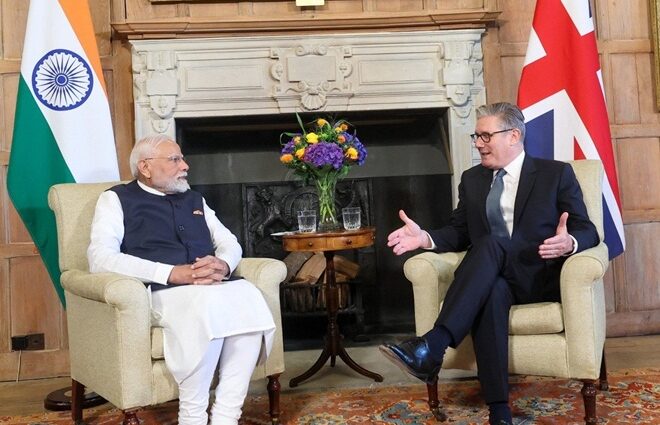
Prime Minister Narendra Modi who is on official visit to the UK, welcomed the signing of the India-UK trade deal terming CETA as a blueprint for shared prosperity.
“This agreement is more than just an economic partnership; it is also a blueprint for shared prosperity. On the one hand, it paves the way for enhanced market access in the UK for Indian textiles, footwear, gems and jewellery, seafood, and engineering goods. It will also unlock new opportunities for India’s agricultural produce and processed food industry. Above all, this agreement will be especially beneficial for India’s youth, farmers, fishermen, and the MSME sector,” he said.