
TLI Staff
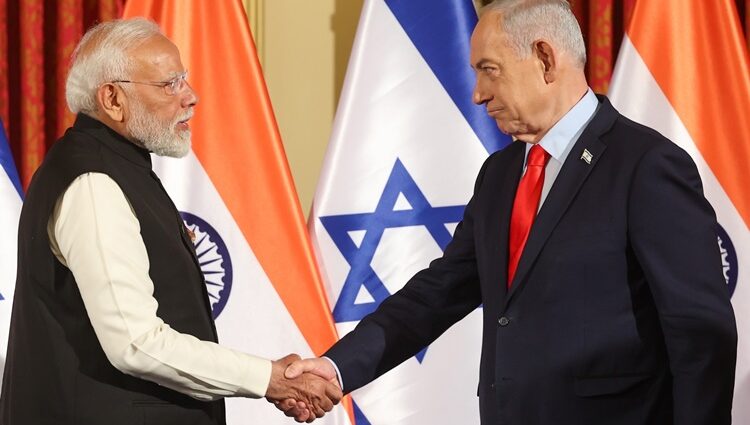
New Delhi/Tel Aviv: India and Israel on Wednesday elevated their bilateral ties to a “Special Strategic Partnership for Peace, Innovation and Prosperity”, following Prime Minister Narendra Modi’s state visit to Israel from February 25–26 at the invitation of Israeli Prime Minister Benjamin Netanyahu.
The two leaders reviewed the full spectrum of bilateral cooperation and outlined an ambitious roadmap spanning defence, emerging technologies, trade, agriculture, cybersecurity and people-to-people ties. The visit builds on the momentum of Modi’s landmark 2017 visit to Israel and Netanyahu’s 2018 visit to India.
Defence, Security and Counter-Terror Cooperation
The Prime Ministers welcomed the Memorandum of Understanding on Defence Cooperation signed in November 2025 and laid out a future roadmap to scale up collaboration in defence production and technology.
In a strong joint statement, both leaders unequivocally condemned terrorism in all its forms, including cross-border terror. They condemned the October 7, 2023 attack on Israel, the April 22, 2025 attack on Indian tourists in Pahalgam, and the November 10, 2025 terror incident near Red Fort in New Delhi.
Reaffirming their resolve as “two vibrant and resilient democracies,” the leaders called for sustained international efforts to combat terrorism and underlined the need for a just and durable peace in West Asia. They also welcomed US President Donald Trump’s comprehensive plan to end the Gaza conflict.
Cybersecurity emerged as a key pillar of cooperation. The two sides agreed to develop a multi-year strategic cybersecurity programme, deepen institutional dialogue and establish an India–Israel Centre of Excellence in Cybersecurity in India. A roadmap will include capacity building, AI integration, applied research and joint exercises.
Tech, AI and Innovation at the Core of New Partnership
Technology and innovation formed the centrepiece of the upgraded partnership. Both leaders committed to integrating strengths in artificial intelligence (AI), semiconductors, quantum computing, biotechnology, cybersecurity, space, agriculture technologies and defence platforms.
They welcomed a new initiative on Critical and Emerging Technologies led by the National Security Advisors of both countries. An MoU on cooperation in Artificial Intelligence was signed to deepen collaboration in AI talent, research and institutional linkages.
The leaders reviewed progress under the India-Israel Industrial R&D and Innovation Fund (I4F) and agreed to strengthen outreach to industry to unlock its full potential. Funding under the India-Israel Joint Research Calls was increased from USD 1 million to USD 1.5 million each, boosting university-level research collaboration.
In the space sector, cooperation between the Indian Space Research Organisation and the Israel Space Agency will be expanded, encouraging joint ventures and innovation partnerships.
The two sides also signed a Declaration of Intent on a Horizon Scanning/Strategic Foresight Mechanism to identify emerging global trends using data and AI for strategic planning.
Trade, Fintech and Connectivity Push
The leaders emphasised unlocking the full potential of trade and investment ties. They welcomed the signing of the India-Israel Bilateral Investment Agreement and the Terms of Reference for negotiations on a Free Trade Agreement (FTA), directing teams to expedite talks.
A major highlight was fintech cooperation. Netanyahu praised India’s Unified Payments Interface (UPI) as a global model for real-time digital payments. Both sides agreed to explore linking UPI with Israel’s fast payment system. An MoU was signed between NPCI International and MASAV to examine cross-border payment linkages.
The two sides also launched an India–Israel Financial Dialogue and committed to enhancing financial-cyber resilience through joint simulations and intelligence-sharing mechanisms.
On connectivity, both leaders expressed the desire to expand direct air connectivity between Tel Aviv and major Indian cities and encouraged airlines to begin direct flight operations.
Agriculture, Water, Education and Workforce Mobility
Reinforcing cooperation in agriculture and water management, the leaders reviewed the progress of 35 operational Centres of Excellence in India, with eight more being jointly developed. Over one million Indian farmers have reportedly benefited from training programmes.
An MoU was signed between the Indian Council of Agricultural Research and MASHAV to establish the India–Israel Innovation Centre for Agriculture (IINCA). Twenty joint agricultural research fellowships were also launched.
The two countries agreed to strengthen cooperation in fisheries, aquaculture, desalination, wastewater reuse and river cleaning, including the Ganges.
On workforce mobility, both leaders reviewed the implementation of agreements facilitating Indian workers in Israel’s construction and caregiver sectors. They welcomed the signing of additional protocols covering commerce, services, manufacturing and restaurants. Up to 50,000 additional Indian workers may travel to Israel over the next five years.
In education, both countries agreed to establish the India–Israel Academic Cooperation Forum (I2I Forum), a university-led platform for high-level dialogue. They also signed MoUs to promote AI-enabled education and academic exchanges.
Regional Connectivity and Global Initiatives
The leaders reaffirmed their commitment to multilateral initiatives such as I2U2 and discussed advancing cooperation under the India-Middle East-Europe Economic Corridor (IMEC) to boost regional connectivity and economic stability.
A total of 16 agreements and protocols were signed across sectors including AI, cybersecurity, agriculture, fisheries, geophysical exploration, maritime heritage, arbitration, financial regulation and worker mobility.
Reaffirming their shared vision, Modi and Netanyahu pledged to maintain high-level engagement across governments, industries and peoples, aiming to build an enduring partnership powered by technology, innovation and shared prosperity.